
What Integrity Looked Like in One Room
Updated: 3 days ago
A case study in why good design begins after you’ve lived in a space.
After living in a space for about 90 days, something shifts.
You begin to understand the room.
You notice where the best light falls in the morning.
Where the heaviest foot traffic naturally forms.
Where you tend to sit at the end of the day.
Where storage actually needs to live.
You start to understand how the space wants to be used.
Before that, most design decisions are guesses.
This became very clear in a recent living room project for someone I’ve known since college — a finance professional in her twenties who had just moved into a Portland apartment and wanted help making her living room feel like home.

Before 
Before 
Before 
Before 
Before
The Brief
Her goals were simple:
Create a refreshing sanctuary using mostly secondhand furniture, with a few thoughtful new pieces if needed.
She imagined adding a collapsible table for dining and working, along with bar stools, and wanted help with furniture placement so the small space would feel open and functional.
She was drawn to:
Natural fiber rugs like jute
Corduroy textures
Earth tones
Mid-century modern pieces
More importantly, she wanted the room to feel:
Cozy. Proud. Inspired. Grounded. Purposeful.
The First Decision: Do Nothing (Yet)
When people move into a new space, they often try to finish it immediately.
New furniture. New layouts. New purchases.
But the truth is: the items you bring from your previous home were chosen for a different space, and they rarely fit perfectly in the new one.
So instead of immediately buying new furniture, I suggested something simpler.
We paused the idea of the collapsible table and bar stools.
First, we worked with what she already owned.
I created three possible furniture layouts for her living room based on the room’s size, orientation, and circulation.
Within a weekend, she had enthusiastically rearranged the space using one of the layouts.
Her message afterward was simple:
“It’s refreshing to walk into now.”
Nothing new had been purchased.
Only the layout changed.

Furniture Plan 1 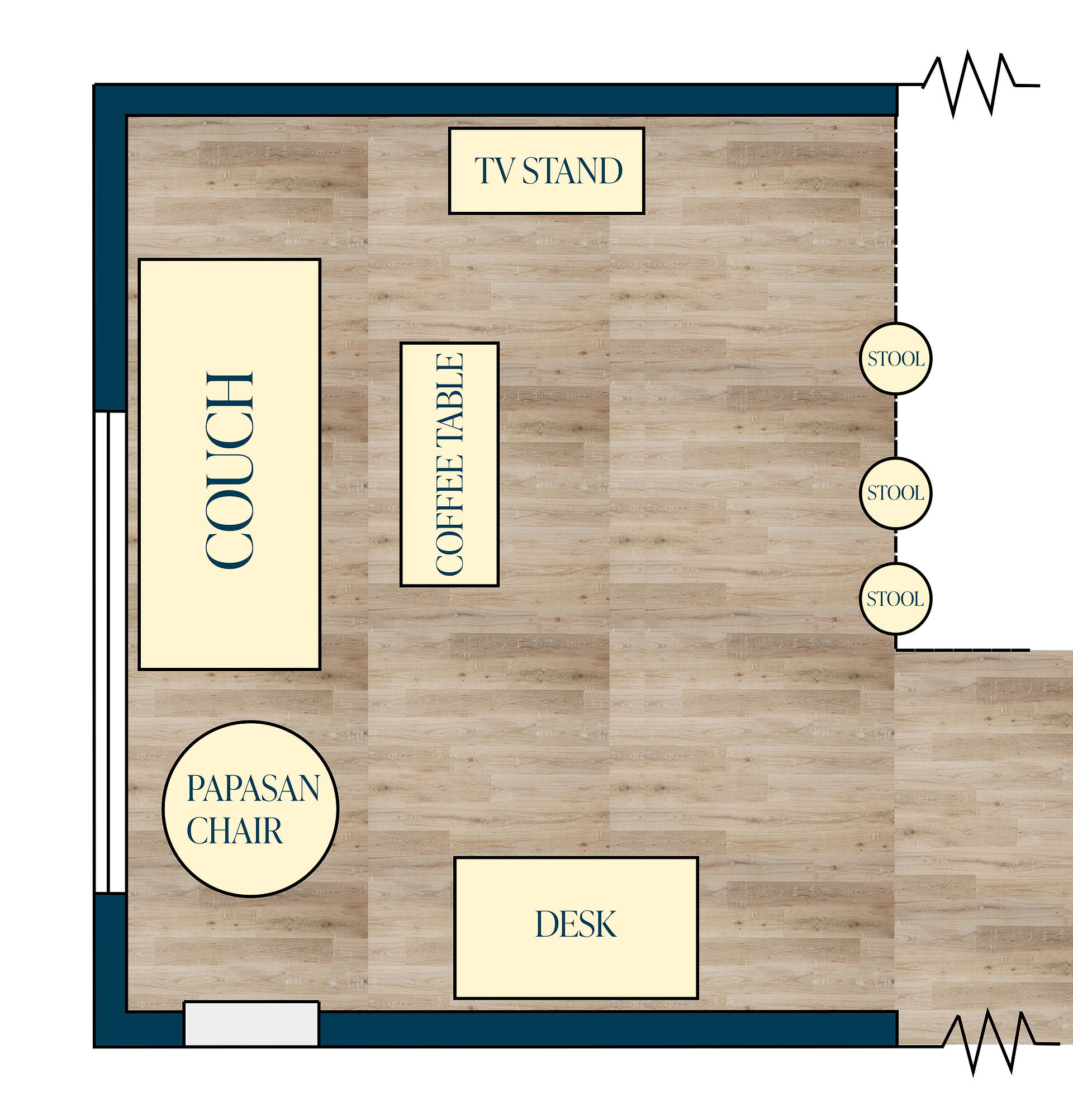
Furniture Plan 2 
Furniture Plan 3
Let the Room Reveal Itself
Once the layout worked, we could begin thinking about what the room actually needed.
Instead of the collapsible table she originally wanted, I suggested something different: a mid-century modern coffee table.
A collapsible table solves a temporary problem.
A well-made coffee table becomes a long-term piece — something that will still work when she eventually moves into a larger space.
For seating at the counter, we found a single bar stool that fit her style and the scale of the apartment perfectly.
Rather than forcing a matching set, I suggested mixing pieces over time to suit her eclectic taste.
The bar stool also eliminated the need for a dining table entirely — she could now eat and work comfortably at the kitchen counter.
One small decision simplified the room.
The Final Piece
A few weeks later, after living in the newly arranged space, she reached out again.
Something was still missing.
As summer faded and evenings became darker earlier, the room needed better lighting.
Her instinct this time was right.
She asked for an arched floor lamp.
Now the room had something it didn’t before: evening atmosphere.

After 
After
What This Project Reinforced
Design is rarely about finding the perfect object immediately.
It’s about understanding how a space is used.
That understanding only comes with time.
Give a room 90 days and patterns begin to appear:
where you gather
where light matters
where clutter forms
where comfort actually lives
Once those patterns reveal themselves, good design decisions become obvious.
Integrity in design doesn’t come from filling a room quickly.
It comes from listening to how a space wants to be lived in.
If You’re Designing Your Own Space
Start with what you already own.
Rearrange before you replace.
And give the room time to reveal what it actually needs.
Good design rarely arrives all at once.
It unfolds.


Comments